
April Hownikan Article
As I begin, I want to acknowledge that this column will sound more pointed than what you may be used to from me. Today I am choosing to be more direct. I believe low voter participation is one of the greatest threats to our sovereignty, and it deserves honest reflection.
Before I get into that, I want to invite District 1 citizens to join us for our next meeting on May 16 from 10 AM to 2 PM. Laura and Brian Hewuse will be joining us to help lead a loom craft project. For details and to RSVP, visit https://www.cpndistrict1.com/events/may16. To stay informed about upcoming events, visit https://cpndistrict1.com/events.
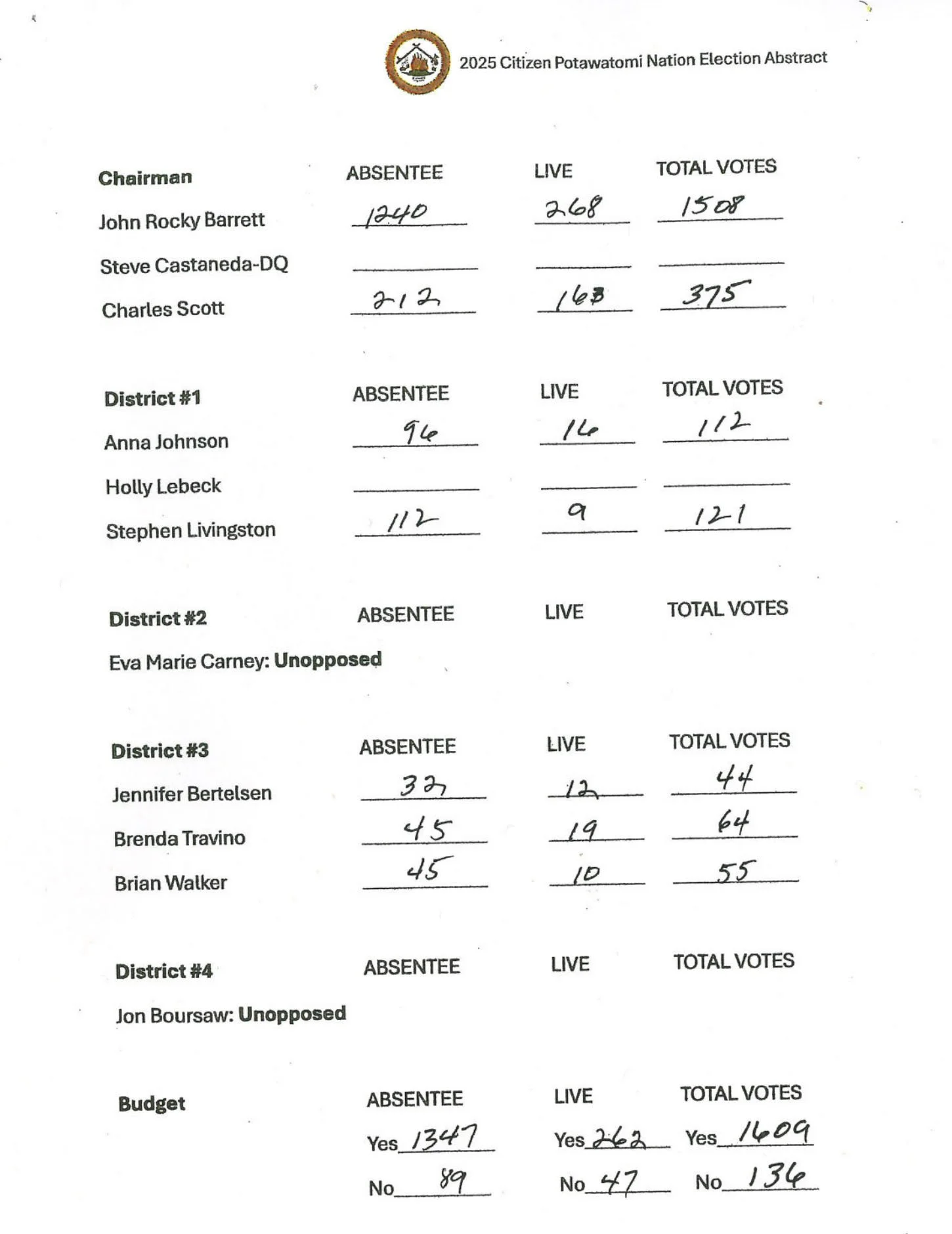
We are nearly 40,000 citizens strong. That number should represent energy, vision, and participation. Yet in recent CPN-wide elections, total ballots cast have hovered under 2,500 voters. Out of nearly 40,000 citizens, that is roughly 6 or 7 percent participation. As our citizenship continues to climb, our civic participation appears to be stagnant or in decline.
What does it mean to be Potawatomi? What does it mean to be a Citizen of the Citizen Potawatomi Nation?
Being Potawatomi is identity. Ancestry, language, ceremony, and survival all define who we are and where we come from. Citizenship is participation in a sovereign government. It’s the community to which we belong. It is how we protect our rights and ensure our Nation continues as a self-governing body with real authority.
Sovereignty is not symbolic. It is practiced.
Our sovereignty has never been guaranteed. We endured forced removal, boarding schools meant to erase our identity, and federal policies during the termination era that openly sought to dissolve tribal governments altogether.
Our constitutional authority, courts, enterprises, and elected leadership are not accidental. They exist because previous generations protected them.
When we choose not to vote, we step back from one of the clearest expressions of that sovereignty.
A Nation cannot be sustained by heritage alone. Culture and pride matter, but sovereignty is exercised through participation. When turnout remains in the single digits, it narrows the mandate behind our leadership and weakens the visible strength of our government.
In his October Hownikan column, Chairman Barrett pointed out that I was elected with 121 votes. He was right to note it. In a district of roughly 3,000 citizens, that number should cause all of us to pause.
But when Nation-wide races like last year’s Chairman election were decided by just 1,883 ballots out of nearly 40,000 citizens, the same reality exists at every level of government.
This is not about any one office. When turnout stays low, leadership across the board is supported by only a small fraction of our community. That should concern us all.
I understand why some people do not vote. Some do not feel informed. Some feel disconnected. Some believe one vote does not matter. We are busy and life pulls on all of us. Those concerns are real.
Still, participation is not optional if we want to remain a Nation that governs itself. Citizenship requires more than pride in who we are. It requires engagement in how we are governed.
If we want stronger mandates, stronger institutions, and a stronger voice as a sovereign Nation, that begins with us. It begins with conversations in our homes. It begins with reminding one another when elections are approaching. It begins with taking the time to learn about candidates and casting a ballot, even when the choices are imperfect.
We have endured too much in our history to drift into the background of our own government.
The next chapter of the Citizen Potawatomi Nation is ours to write.
For official election information, please visit:
https://www.potawatomi.org/government/elections/
For direct questions, the Election Committee can be contacted at:
elections@potawatomi.org
